Recent discussion around the DMM Kinisi harness rope/webbing bridge has highlighted a broader issue in modern climbing systems: the distinction between certified and compatible hardware, and where responsibility lies when the two differ.
This is not about one harness or one manufacturer. It is about understanding certification, competence, and accountability in professional arborist equipment.
Certified Hardware: What It Means
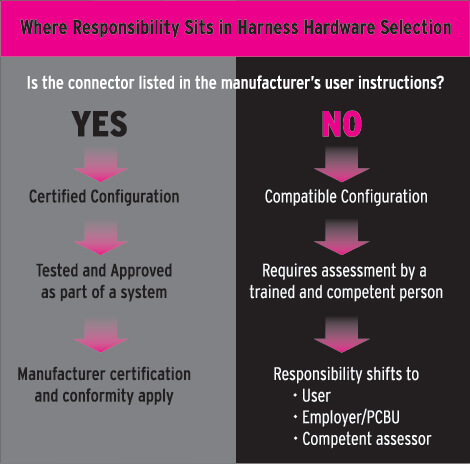
Certified hardware is equipment specifically listed in a manufacturer’s user instructions.
When hardware is certified:
- It is named in the instructions.
- It has been tested in this exact configuration.
- It is part of the product’s official certification.
- Responsibility for safe use lies with the user when following the manufacturer’s certified configurations.
Using listed hardware means relying on a system that has been designed, tested, and approved.
Compatible Hardware Is Not Certified Hardware
A connector may fit a rope or webbing bridge but not be certified for use in that system.
Compatible hardware:
- It is not listed in the user instructions.
- It has not been certified as part of that system.
- It requires assessment by a trained and competent person.
If you use hardware not listed by the manufacturer, you are solely responsible for ensuring it is suitable and safe.
The DMM Statement (In Full)
In response to the social media discussion, DMM issued the following statement on 22 January, 2026:
“The DMM User Instructions for the Kinisi Harness provide examples of DMM products which are compatible with rope bridges and examples of DMM products which are compatible with webbing bridges. A trained and competent person can assess and select a compatible connector(s), which may or may not be listed in the DMM Kinisi instructions. It is the competent person’s responsibility to ensure suitable and sufficient performance, as well as correct and safe compatibility with neighbouring equipment. Ensuring any components used meet the requirements of the certification(s) and jurisdiction(s), within which you carry out work.”
Understanding why DMM issued this statement—and interpreting it correctly—is crucial.
What the Statement Says (and What It Doesn’t)
The statement confirms that:
- The user instructions provide examples, not an exhaustive list.
- A competent person may select alternative connectors.
- Selecting unlisted connectors places responsibility for their safety and compliance on the user or employer.
It does not say that:
- Unlisted hardware is certified.
- Responsibility remains with the manufacturer.
- All connectors are interchangeable.
The certified versus compatible distinction remains.
To make this distinction actionable, clarify what makes someone a “trained and competent person.”
In professional climbing systems, competence is not assumed.
A competent person must be able to assess:
- Loading direction and cross-loading risk.
- Gate orientation and interference.
- Dimensional compatibility with rope or webbing bridges.
- Wear between metal, rope, and textile parts.
- Relevant PPE standards and their limitations.
Competence is a technical and legal requirement.
Certification, New Zealand Law, and Responsibility
Under New Zealand workplace safety law, PPE must be:
- Fit for purpose.
- Used as intended.
- Supported by safe systems of work.
Using a system outside the manufacturer’s configuration usually requires:
- A documented risk assessment.
- Clear justification for the hardware choice.
- Acceptance of responsibility by the user or employer.
This applies regardless of how common or familiar the alternative hardware may be.
Why Manufacturers List Specific Hardware
PPE certification is configuration-specific.
Manufacturers list connectors because:
- They have been tested in that setup.
- Load paths and wear points are known.
- Certification depends on defined combinations.
Open-ended compatibility would undermine the certification frameworks professional arborists rely on.
Where Treetools Stands
As a specialist trade supplier, Treetools supplies equipment in line with:
- Manufacturer instructions.
- Certification documentation.
- New Zealand safety requirements.
We may discuss compatible options where appropriate, but only label options as certified if the manufacturer explicitly states that they are certified. In all other cases, responsibility for suitability and safety rests with the user or employer.
Before choosing non-listed hardware, reflect on these practical questions to reinforce accountability:
- Does it meet certification requirements in my jurisdiction?
- Am I prepared to justify this decision to my employer, regulatory authorities, or in a legal setting as a competent person?
Modern climbing systems allow flexibility—but flexibility comes with responsibility.
The Takeaway
Certified and compatible hardware are different. Know both and understand your responsibility.
Each choice in climbing gear demands clear accountability. Make informed decisions and commit to safety every time you rig or climb.